Moon Vocabulary
The Moon is Earth's natural satellite and has fascinated scientists and sky watchers for centuries with its phases, surface features, and influence on our planet. This free printable moon vocabulary list provides definitions for important terms and can be used for classroom learning, vocabulary review, and related puzzle activities.


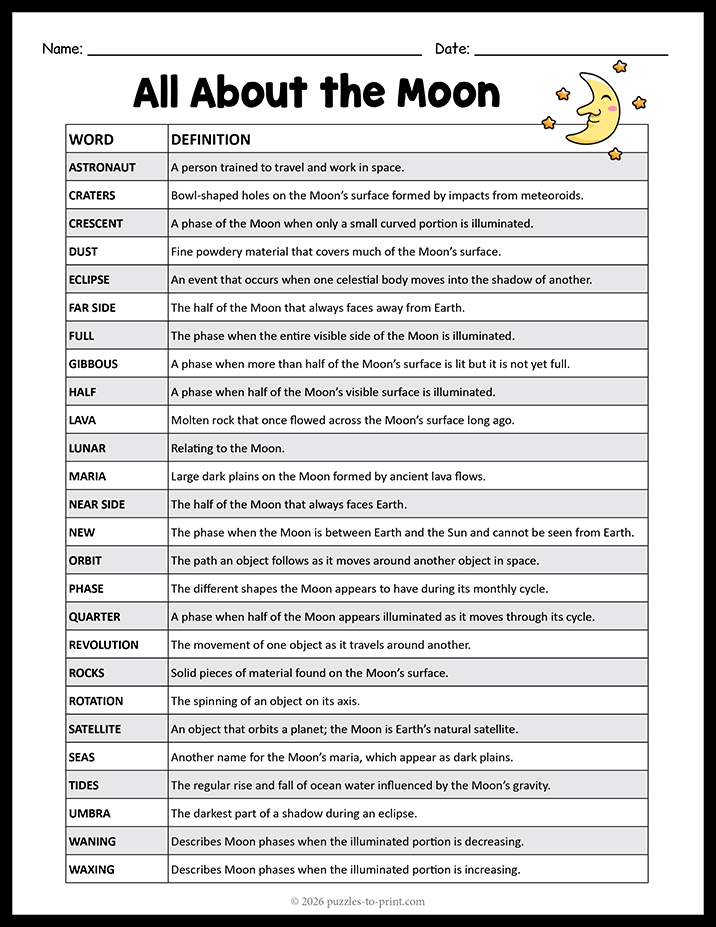
Moon Terms and Definitions
| Word | Definition |
|---|---|
| Astronaut | A person trained to travel and work in space. |
| Craters | Bowl-shaped holes on the Moon’s surface formed by impacts from meteoroids. |
| Crescent | A phase of the Moon when only a small curved portion is illuminated. |
| Dust | Fine powdery material that covers much of the Moon’s surface. |
| Eclipse | An event that occurs when one celestial body moves into the shadow of another. |
| Far Side | The half of the Moon that always faces away from Earth. |
| Full | The phase when the entire visible side of the Moon is illuminated. |
| Gibbous | A phase when more than half of the Moon’s surface is lit but it is not yet full. |
| Half | A phase when half of the Moon’s visible surface is illuminated. |
| Lava | Molten rock that once flowed across the Moon’s surface long ago. |
| Lunar | Relating to the Moon. |
| Maria | Large dark plains on the Moon formed by ancient lava flows. |
| Near Side | The half of the Moon that always faces Earth. |
| New | The phase when the Moon is between Earth and the Sun and cannot be seen from Earth. |
| Orbit | The path an object follows as it moves around another object in space. |
| Phase | The different shapes the Moon appears to have during its monthly cycle. |
| Quarter | A phase when half of the Moon appears illuminated as it moves through its cycle. |
| Revolution | The movement of one object as it travels around another. |
| Rocks | Solid pieces of material found on the Moon’s surface. |
| Rotation | The spinning of an object on its axis. |
| Satellite | An object that orbits a planet; the Moon is Earth’s natural satellite. |
| Seas | Another name for the Moon’s maria, which appear as dark plains. |
| Tides | The regular rise and fall of ocean water influenced by the Moon’s gravity. |
| Umbra | The darkest part of a shadow during an eclipse. |
| Waning | Describes Moon phases when the illuminated portion is decreasing. |
| Waxing | Describes Moon phases when the illuminated portion is increasing. |
Practice What You Have Learned
These related moon puzzles provide a fun way to review and reinforce the vocabulary terms listed above.


Find more printable vocabulary lists to support your classroom teaching.
How to Use This Moon Vocabulary List
Students can review the terms before beginning an moon themed puzzle, refer to the definitions while completing an activity, or use the vocabulary list afterward for reinforcement. It is also useful for introducing new science words before a lesson on moon.
For younger students, you may want to choose a few key words from the list and discuss them together. Older students can use the full list as a study guide or as support while completing independent work.
Teaching Ideas
Try asking students to choose several vocabulary words and use each one in a sentence. They can also sort the terms.
Another simple activity is to have students cover the definitions and quiz themselves or a partner. This helps turn the list into an active vocabulary review instead of just a reference page.