Force and Motion Vocabulary
Force and motion help explain how objects move and interact, from a rolling ball to the motion of planets in space. This free printable force and motion vocabulary list provides definitions for important terms and can be used for classroom learning, vocabulary review, and related puzzle activities.


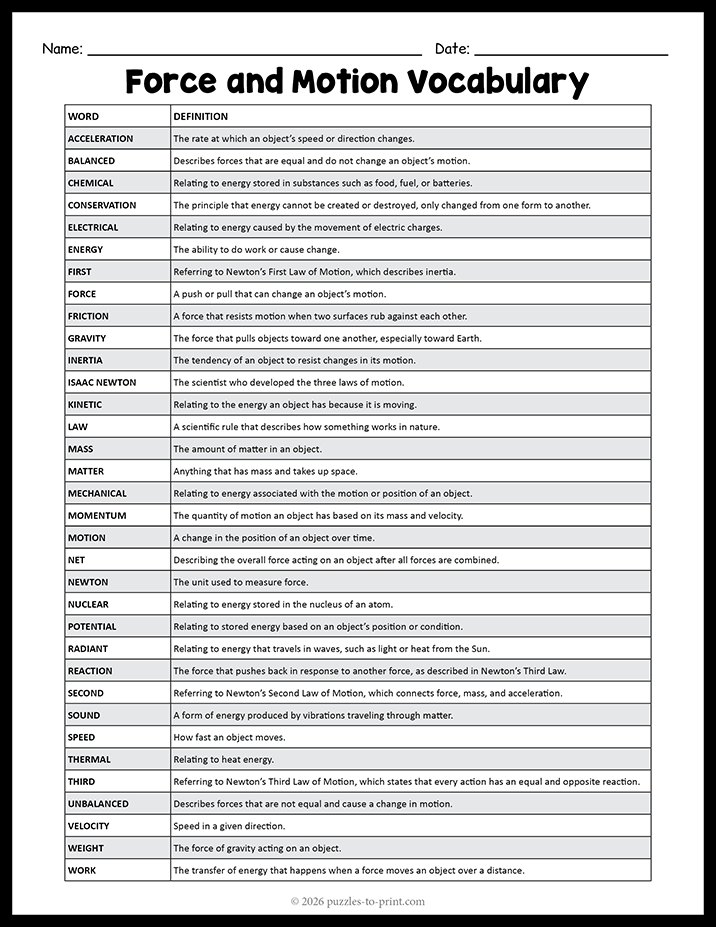
Force and Motion Terms and Definitions
| Word | Definition |
|---|---|
| Acceleration | The rate at which an object’s speed or direction changes. |
| Balanced | Describes forces that are equal and do not change an object’s motion. |
| Chemical | Relating to energy stored in substances such as food, fuel, or batteries. |
| Conservation | The principle that energy cannot be created or destroyed, only changed from one form to another. |
| Electrical | Relating to energy caused by the movement of electric charges. |
| Energy | The ability to do work or cause change. |
| First | Referring to Newton’s First Law of Motion, which describes inertia. |
| Force | A push or pull that can change an object’s motion. |
| Friction | A force that resists motion when two surfaces rub against each other. |
| Gravity | The force that pulls objects toward one another, especially toward Earth. |
| Inertia | The tendency of an object to resist changes in its motion. |
| Isaac Newton | The scientist who developed the three laws of motion. |
| Kinetic | Relating to the energy an object has because it is moving. |
| Law | A scientific rule that describes how something works in nature. |
| Mass | The amount of matter in an object. |
| Matter | Anything that has mass and takes up space. |
| Mechanical | Relating to energy associated with the motion or position of an object. |
| Momentum | The quantity of motion an object has based on its mass and velocity. |
| Motion | A change in the position of an object over time. |
| Net | Describing the overall force acting on an object after all forces are combined. |
| Newton | The unit used to measure force. |
| Nuclear | Relating to energy stored in the nucleus of an atom. |
| Potential | Relating to stored energy based on an object’s position or condition. |
| Radiant | Relating to energy that travels in waves, such as light or heat from the Sun. |
| Reaction | The force that pushes back in response to another force, as described in Newton’s Third Law. |
| Second | Referring to Newton’s Second Law of Motion, which connects force, mass, and acceleration. |
| Sound | A form of energy produced by vibrations traveling through matter. |
| Speed | How fast an object moves. |
| Thermal | Relating to heat energy. |
| Third | Referring to Newton’s Third Law of Motion, which states that every action has an equal and opposite reaction. |
| Unbalanced | Describes forces that are not equal and cause a change in motion. |
| Velocity | Speed in a given direction. |
| Weight | The force of gravity acting on an object. |
| Work | The transfer of energy that happens when a force moves an object over a distance. |
Practice What You Have Learned
These related force and motion puzzles provide a fun way to review and reinforce the vocabulary terms listed above.


Find more printable vocabulary lists to support your classroom teaching.
How to Use This Force and Motion Vocabulary List
Students can review the terms before beginning an force and motion themed puzzle, refer to the definitions while completing an activity, or use the vocabulary list afterward for reinforcement. It is also useful for introducing new science words before a lesson on force and motion.
For younger students, you may want to choose a few key words from the list and discuss them together. Older students can use the full list as a study guide or as support while completing independent work.
Teaching Ideas
Try asking students to choose several vocabulary words and use each one in a sentence. They can also sort the terms.
Another simple activity is to have students cover the definitions and quiz themselves or a partner. This helps turn the list into an active vocabulary review instead of just a reference page.