Earth Science Vocabulary
Earth science explores the processes and systems that shape our planet, including weather, geology, oceans, and natural resources. This free printable earth science vocabulary list provides definitions for important terms and can be used for classroom learning, vocabulary review, and related puzzle activities.


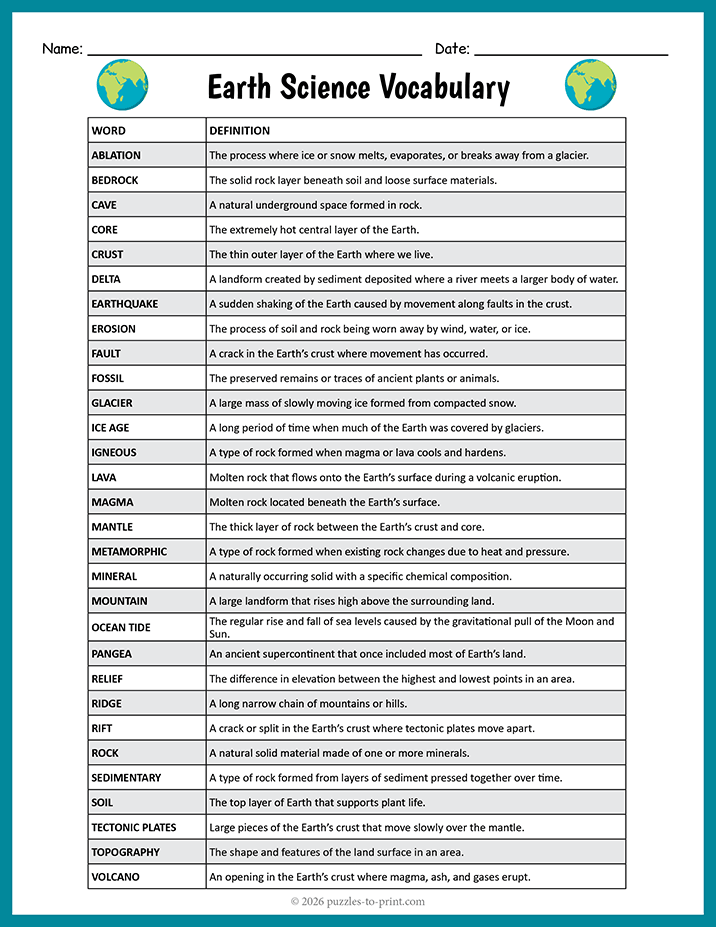
Earth Science Terms and Definitions
| Word | Definition |
|---|---|
| Ablation | The process where ice or snow melts, evaporates, or breaks away from a glacier. |
| Bedrock | The solid rock layer beneath soil and loose surface materials. |
| Cave | A natural underground space formed in rock. |
| Core | The extremely hot central layer of the Earth. |
| Crust | The thin outer layer of the Earth where we live. |
| Delta | A landform created by sediment deposited where a river meets a larger body of water. |
| Earthquake | A sudden shaking of the Earth caused by movement along faults in the crust. |
| Erosion | The process of soil and rock being worn away by wind, water, or ice. |
| Fault | A crack in the Earth’s crust where movement has occurred. |
| Fossil | The preserved remains or traces of ancient plants or animals. |
| Glacier | A large mass of slowly moving ice formed from compacted snow. |
| Ice Age | A long period of time when much of the Earth was covered by glaciers. |
| Igneous | A type of rock formed when magma or lava cools and hardens. |
| Lava | Molten rock that flows onto the Earth’s surface during a volcanic eruption. |
| Magma | Molten rock located beneath the Earth’s surface. |
| Mantle | The thick layer of rock between the Earth’s crust and core. |
| Metamorphic | A type of rock formed when existing rock changes due to heat and pressure. |
| Mineral | A naturally occurring solid with a specific chemical composition. |
| Mountain | A large landform that rises high above the surrounding land. |
| Ocean Tide | The regular rise and fall of sea levels caused by the gravitational pull of the Moon and Sun. |
| Pangea | An ancient supercontinent that once included most of Earth’s land. |
| Relief | The difference in elevation between the highest and lowest points in an area. |
| Ridge | A long narrow chain of mountains or hills. |
| Rift | A crack or split in the Earth’s crust where tectonic plates move apart. |
| Rock | A natural solid material made of one or more minerals. |
| Sedimentary | A type of rock formed from layers of sediment pressed together over time. |
| Soil | The top layer of Earth that supports plant life. |
| Tectonic Plates | Large pieces of the Earth’s crust that move slowly over the mantle. |
| Topography | The shape and features of the land surface in an area. |
| Volcano | An opening in the Earth’s crust where magma, ash, and gases erupt. |
Practice What You Have Learned
These related earth science puzzles provide a fun way to review and reinforce the vocabulary terms listed above.


Find more printable vocabulary lists to support your classroom teaching.
How to Use This Earth Science Vocabulary List
Students can review the terms before beginning an earth science themed puzzle, refer to the definitions while completing an activity, or use the vocabulary list afterward for reinforcement. It is also useful for introducing new science words before a lesson on earth science.
For younger students, you may want to choose a few key words from the list and discuss them together. Older students can use the full list as a study guide or as support while completing independent work.
Teaching Ideas
Try asking students to choose several vocabulary words and use each one in a sentence. They can also sort the terms.
Another simple activity is to have students cover the definitions and quiz themselves or a partner. This helps turn the list into an active vocabulary review instead of just a reference page.