Chemistry Vocabulary
Chemistry is the study of matter and the changes it undergoes, helping us understand the substances that make up the world around us. This free printable chemistry vocabulary list provides definitions for important terms and can be used for classroom learning, vocabulary review, and related puzzle activities.


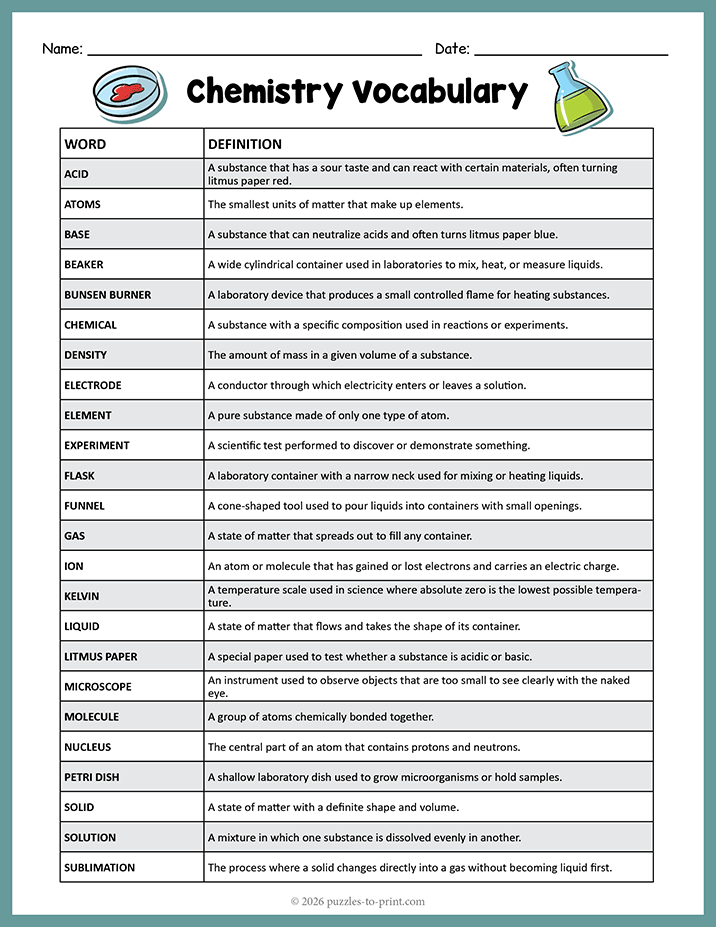
Chemistry Terms and Definitions
| Word | Definition |
|---|---|
| Acid | A substance that has a sour taste and can react with certain materials, often turning litmus paper red. |
| Atoms | The smallest units of matter that make up elements. |
| Base | A substance that can neutralize acids and often turns litmus paper blue. |
| Beaker | A wide cylindrical container used in laboratories to mix, heat, or measure liquids. |
| Bunsen Burner | A laboratory device that produces a small controlled flame for heating substances. |
| Chemical | A substance with a specific composition used in reactions or experiments. |
| Density | The amount of mass in a given volume of a substance. |
| Electrode | A conductor through which electricity enters or leaves a solution. |
| Element | A pure substance made of only one type of atom. |
| Experiment | A scientific test performed to discover or demonstrate something. |
| Flask | A laboratory container with a narrow neck used for mixing or heating liquids. |
| Funnel | A cone-shaped tool used to pour liquids into containers with small openings. |
| Gas | A state of matter that spreads out to fill any container. |
| Ion | An atom or molecule that has gained or lost electrons and carries an electric charge. |
| Kelvin | A temperature scale used in science where absolute zero is the lowest possible temperature. |
| Liquid | A state of matter that flows and takes the shape of its container. |
| Litmus paper | A special paper used to test whether a substance is acidic or basic. |
| Microscope | An instrument used to observe objects that are too small to see clearly with the naked eye. |
| Molecule | A group of atoms chemically bonded together. |
| Nucleus | The central part of an atom that contains protons and neutrons. |
| Petri Dish | A shallow laboratory dish used to grow microorganisms or hold samples. |
| Solid | A state of matter with a definite shape and volume. |
| Solution | A mixture in which one substance is dissolved evenly in another. |
| Sublimation | The process where a solid changes directly into a gas without becoming liquid first. |
| Test Tube | A narrow glass tube used for holding or mixing small amounts of substances. |
| Thermometer | An instrument used to measure temperature. |
| Volume | The amount of space that a substance occupies. |
Practice What You Have Learned
These related chemistry puzzles provide a fun way to review and reinforce the vocabulary terms listed above.


How to Use This Chemistry Vocabulary List
Students can review the terms before beginning a chemistry lesson, refer to the definitions while completing assignments, or use the vocabulary list afterward as a study aid. Having key words and definitions in one place can make unfamiliar science vocabulary easier to understand.
For younger students, the vocabulary list can be used to introduce basic chemistry words before a unit begins. Older students can use it as a quick reference while reviewing concepts such as atoms, molecules, mixtures, solutions, and reactions.
Teaching Ideas
Ask students to sort the terms into categories such as matter, measurement, laboratory tools, elements, compounds, and chemical reactions. This helps students see how individual vocabulary words connect to larger chemistry concepts.
Students can also choose several words and write their own example sentences, create flash cards, or quiz a partner. These simple activities turn the list into an active vocabulary review tool rather than just a reference page.
Find more printable vocabulary lists to support your classroom teaching.