Body Systems Vocabulary
The human body relies on a number of interconnected systems that work together to keep us healthy and functioning properly. This free printable body systems vocabulary list provides definitions for important terms and can be used for classroom learning, vocabulary review, and related puzzle activities.


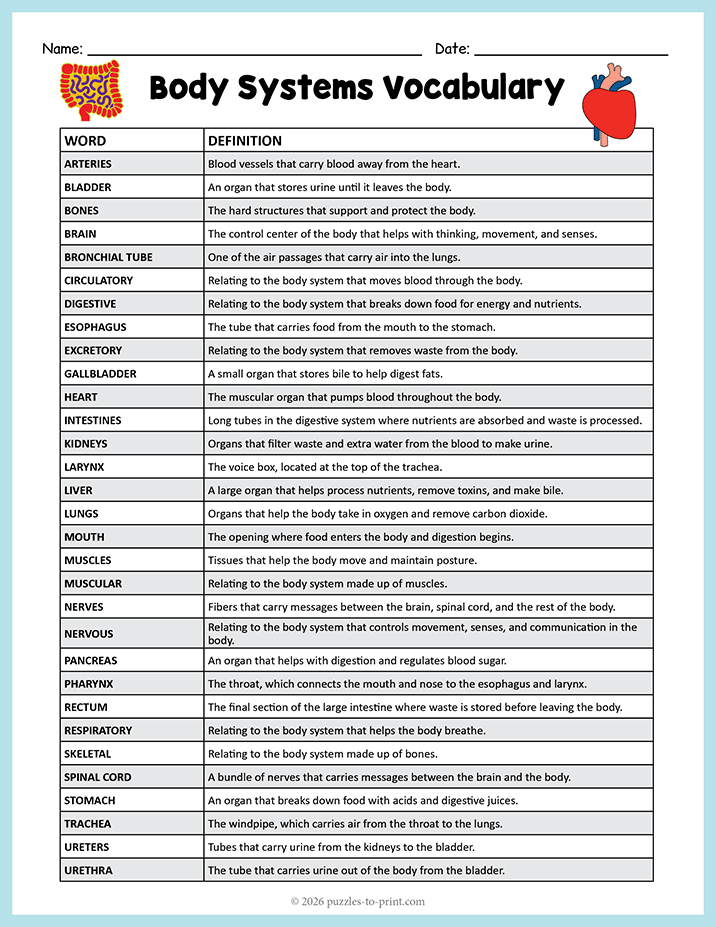
Body Systems Terms and Definitions
| Word | Definition |
|---|---|
| Arteries | Blood vessels that carry blood away from the heart. |
| Bladder | An organ that stores urine until it leaves the body. |
| Bones | The hard structures that support and protect the body. |
| Brain | The control center of the body that helps with thinking, movement, and senses. |
| Bronchial tube | One of the air passages that carry air into the lungs. |
| Circulatory | Relating to the body system that moves blood through the body. |
| Digestive | Relating to the body system that breaks down food for energy and nutrients. |
| Esophagus | The tube that carries food from the mouth to the stomach. |
| Excretory | Relating to the body system that removes waste from the body. |
| Gallbladder | A small organ that stores bile to help digest fats. |
| Heart | The muscular organ that pumps blood throughout the body. |
| Intestines | Long tubes in the digestive system where nutrients are absorbed and waste is processed. |
| Kidneys | Organs that filter waste and extra water from the blood to make urine. |
| Larynx | The voice box, located at the top of the trachea. |
| Liver | A large organ that helps process nutrients, remove toxins, and make bile. |
| Lungs | Organs that help the body take in oxygen and remove carbon dioxide. |
| Mouth | The opening where food enters the body and digestion begins. |
| Muscles | Tissues that help the body move and maintain posture. |
| Muscular | Relating to the body system made up of muscles. |
| Nerves | Fibers that carry messages between the brain, spinal cord, and the rest of the body. |
| Nervous | Relating to the body system that controls movement, senses, and communication in the body. |
| Pancreas | An organ that helps with digestion and regulates blood sugar. |
| Pharynx | The throat, which connects the mouth and nose to the esophagus and larynx. |
| Rectum | The final section of the large intestine where waste is stored before leaving the body. |
| Respiratory | Relating to the body system that helps the body breathe. |
| Skeletal | Relating to the body system made up of bones. |
| Spinal cord | A bundle of nerves that carries messages between the brain and the body. |
| Stomach | An organ that breaks down food with acids and digestive juices. |
| Trachea | The windpipe, which carries air from the throat to the lungs. |
| Ureters | Tubes that carry urine from the kidneys to the bladder. |
| Urethra | The tube that carries urine out of the body from the bladder. |
| Veins | Blood vessels that carry blood back to the heart. |
Practice What You Have Learned
These related body systems puzzles provide a fun way to review and reinforce the vocabulary terms listed above.


Find more printable vocabulary lists to support your classroom teaching.
How to Use This Vocabulary List
Students can review the vocabulary before beginning a lesson, use the list while completing assignments, or refer to it when studying for quizzes and tests. Having important terms and definitions in one place helps build familiarity with scientific language and concepts.
Teachers may also use the vocabulary list as a classroom handout, a reference during discussions, or a source for vocabulary practice activities. Students can challenge themselves by covering the definitions and attempting to explain each term from memory.
Teaching Ideas
Ask students to group terms according to the body system they belong to. This activity helps reinforce the relationship between organs, tissues, and the systems that perform specific functions within the body.
Another effective activity is to have students create diagrams, flash cards, or concept maps using the vocablary. These exercises encourage students to make connections between vocabulary words and the functions of each body system.