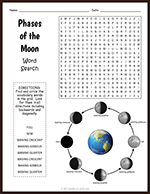
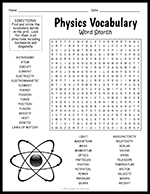
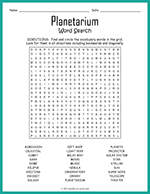
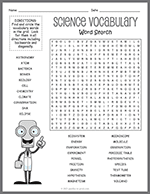
Astronomy Word Search
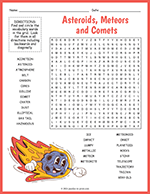
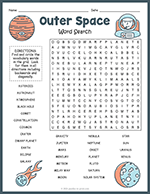
Explore the stars and planets with this engaging astronomy word search puzzle. From galaxies to constellations, this puzzle is sure to challenge and delight all stargazers and space enthusiasts alike.
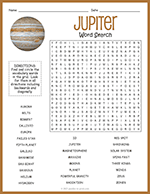
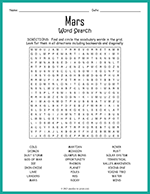
Word list: Asteroid, Comet, Constellation, Copernicus, Crater, Eclipse, Exploration, Galaxy, Galileo, Gravity, Jupiter, Light-year, Lunar, Mars, Meteor, Milky Way, Moon, Nebula, Orbit, Planet, Rings, Satellite, Saturn, Solar system, Space Station, Star, Sun, Telescope, Universe, and Venus
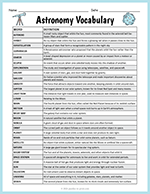
Astronomy Vocabulary
| Word | Definition |
|---|---|
| Asteroid | A small rocky object that orbits the Sun, most commonly found in the asteroid belt between Mars and Jupiter. |
| Comet | An icy object that orbits the Sun and forms a glowing tail when it passes close to the Sun. |
| Constellation | A group of stars that form a recognizable pattern in the night sky. |
| Copernicus | A Renaissance astronomer who proposed that the planets orbit the Sun rather than the Earth. |
| Crater | A bowl-shaped depression on a planet or moon caused by an impact from a meteor or asteroid. |
| Eclipse | An event that occurs when one celestial body moves into the shadow of another. |
| Exploration | The study and investigation of space using telescopes, satellites, and spacecraft. |
| Galaxy | A vast system of stars, gas, and dust held together by gravity. |
| Galileo | An Italian scientist who improved the telescope and made important discoveries about planets and moons. |
| Gravity | The force that attracts objects toward one another, keeping planets in orbit around stars. |
| Jupiter | The largest planet in our solar system, known for its Great Red Spot and many moons. |
| Light-year | The distance that light travels in one year, used to measure vast distances in space. |
| Lunar | Relating to the Moon. |
| Mars | The fourth planet from the Sun, often called the Red Planet because of its reddish surface. |
| Meteor | A streak of light seen when a small space rock burns up in Earth's atmosphere. |
| Milky Way | The galaxy that contains our solar system. |
| Moon | A natural satellite that orbits a planet. |
| Nebula | A giant cloud of gas and dust in space where stars are often formed. |
| Orbit | The curved path an object follows as it travels around another object in space. |
| Planet | A large celestial body that orbits a star and does not produce its own light. |
| Rings | Bands of ice and rock particles that orbit some planets, such as Saturn. |
| Satellite | An object that orbits a planet, either natural like the Moon or artificial like a spacecraft. |
| Saturn | A large gas giant known for its spectacular ring system. |
| Solar System | The Sun and all the planets, moons, asteroids, and other objects that orbit it. |
| Space Station | A spacecraft designed for astronauts to live and work in orbit for extended periods. |
| Star | A massive ball of hot gas that produces light and energy through nuclear fusion. |
| Sun | The star at the center of our solar system that provides light and heat to Earth. |
| Telescope | An instrument used to observe distant objects in space. |
| Universe | All of space and everything in it, including galaxies, stars, planets, and matter. |
| Venus | The second planet from the Sun, known for its thick clouds and extremely hot surface. |