DNA Glossary
This free printable DNA glossary helps students learn and review important vocabulary related to genetics, heredity, and molecular biology. It can be used alongside science lessons, biology units, classroom activities, or our DNA-themed printable puzzles.
Print this glossary for classroom use, science notebooks, study guides, or independent review. It works well as a companion resource for DNA word searches, biology puzzles, and genetics vocabulary activities.
Print Glossary

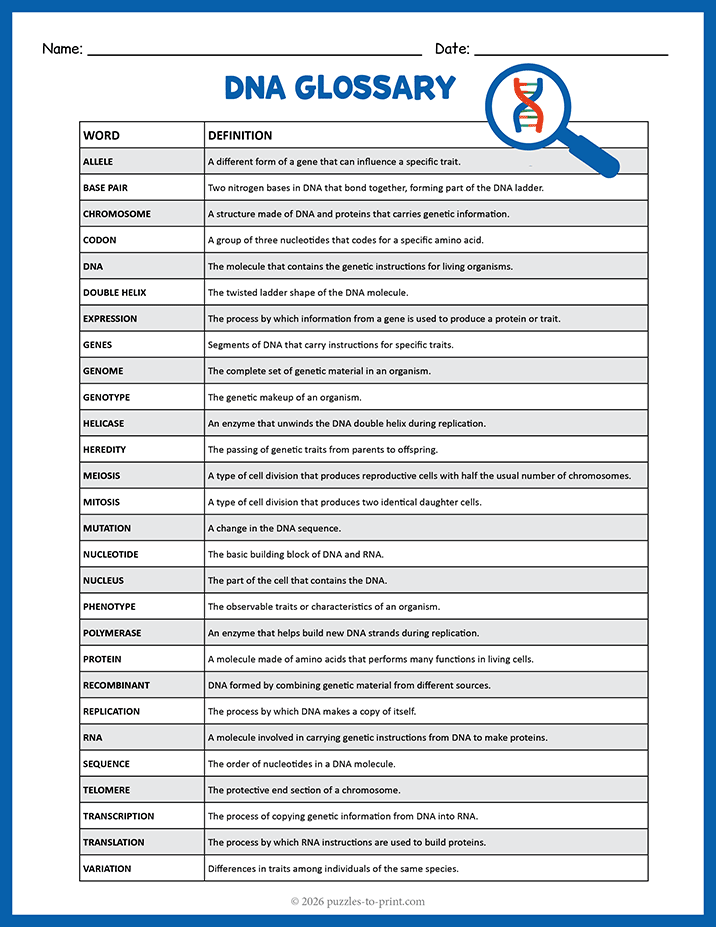
DNA Vocabulary
| Word | Definition |
|---|---|
| Allele | A different form of a gene that can influence a specific trait. |
| Base Pair | Two nitrogen bases in DNA that bond together, forming part of the DNA ladder. |
| Chromosome | A structure made of DNA and proteins that carries genetic information. |
| Codon | A group of three nucleotides that codes for a specific amino acid. |
| DNA | The molecule that contains the genetic instructions for living organisms. |
| Double Helix | The twisted ladder shape of the DNA molecule. |
| Expression | The process by which information from a gene is used to produce a protein or trait. |
| Genes | Segments of DNA that carry instructions for specific traits. |
| Genome | The complete set of genetic material in an organism. |
| Genotype | The genetic makeup of an organism. |
| Helicase | An enzyme that unwinds the DNA double helix during replication. |
| Heredity | The passing of genetic traits from parents to offspring. |
| Meiosis | A type of cell division that produces reproductive cells with half the usual number of chromosomes. |
| Mitosis | A type of cell division that produces two identical daughter cells. |
| Mutation | A change in the DNA sequence. |
| Nucleotide | The basic building block of DNA and RNA. |
| Nucleus | The part of the cell that contains the DNA. |
| Phenotype | The observable traits or characteristics of an organism. |
| Polymerase | An enzyme that helps build new DNA strands during replication. |
| Protein | A molecule made of amino acids that performs many functions in living cells. |
| Recombinant | DNA formed by combining genetic material from different sources. |
| Replication | The process by which DNA makes a copy of itself. |
| RNA | A molecule involved in carrying genetic instructions from DNA to make proteins. |
| Sequence | The order of nucleotides in a DNA molecule. |
| Telomere | The protective end section of a chromosome. |
| Transcription | The process of copying genetic information from DNA into RNA. |
| Translation | The process by which RNA instructions are used to build proteins. |
| Variation | Differences in traits among individuals of the same species. |
More Biology Resources


Find more printable glossaries to support your classroom teaching.
How to Use This DNA Glossary
Students can review the terms before beginning a DNA or genetics lesson, refer to the definitions while completing assignments, or use the glossary afterward as a study tool. Having key vocabulary in one place can make complex science concepts easier to understand.
For younger students, the glossary can introduce basic ideas such as genes, traits, and chromosomes. Older students can use it while studying DNA structure, inheritance, mutations, and the role DNA plays in living organisms.
Teaching Ideas
Ask students to group glossary terms into categories such as DNA structure, inheritance, cell biology, and genetic variation. This helps students see how individual vocabulary words connect to larger biology concepts.
Students can also choose several glossary words and create flash cards, write example sentences, or explain the terms to a partner. These activities turn the glossary into an active review tool rather than just a reference page.